
Stimulation therapies
VNS and DBS
VNS and DBS
If a patient's epilepsy is drug-resistant, i.e. seizure freedom cannot be achieved with anti-seizure medications, and epilepsy surgery is not possible or has not been successful, there is also the option of the stimulation therapies VNS and DBS.
Vagus nerve stimulation (VNS)
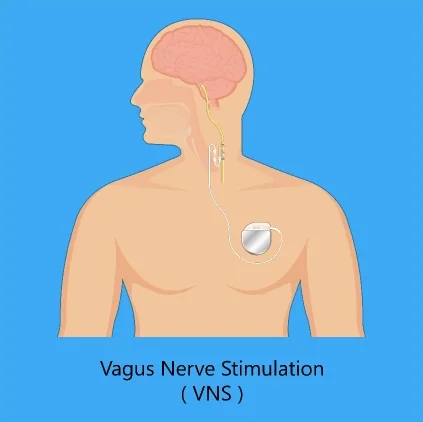
In vagus nerve stimulation, a neurosurgeon wraps a wire around the vagus nerve, which runs deep in the neck, during an operation and positions a pulse generator, the vagus nerve stimulator (VNS), near the armpit. The two are connected by a lead running under the skin.
The VNS can then be read out and programmed by an epileptologist using a handheld device that is held on the skin over the implanted VNS.
In addition to its positive effect on epilepsy, the advantage of the VNS is an additional antidepressant effect. The disadvantage, after a period of habituation, is hoarseness during stimulation, and sometimes also coughing and swallowing difficulties.
In approximately one third of patients, the VNS reduces seizure frequency by at least 50%.
Deep brain stimulation (DBS)
In deep brain stimulation, a neurosurgeon inserts two stimulation electrodes into the patient's head during brain surgery and places a pulse generator, the deep brain stimulator (DBS), at a site on the torso (on the left or right of the chest, or on the right or left above the pelvis). As with the VNS, programming is carried out by an epileptologist with a handheld device through the skin over the implanted DBS.
The advantage is that, unlike with the VNS, the patient does not notice the stimulation. The disadvantage is that excessive stimulation can lead to depression and to memory and concentration problems, although all of these disappear completely again when the stimulation intensity is reduced.
In more than half of patients, seizure frequency is reduced by at least 50%.
Contact us